Click here to subscribe to our Bowles Law e-letter


Click here to subscribe to our Bowles Law e-letter

California employers must maintain a personnel file and a separate confidential file or files -- comprising medical records, private financial records, any applicable equal employment opportunity race, ethnicity and sex identities, and...
California employers must maintain a personnel file and a separate confidential file or files -- comprising medical records, private financial records, any applicable equal employment opportunity race, ethnicity and sex identities, and investigative or litigation files -- for each employee for at least four years after the employment relationship ends.
Employers should include a handbook policy on maintaining, preserving, protecting, and accessing these documents.
Policy Drafting Tips:
Take-Aways:
Implement and regularly review a comprehensive, clearly written handbook to include a personnel records policy.
We publish this series to educate employers on best practices for a well-written handbook that assists applicants, employees, and management alike. To purchase our 2023 template handbook – which contains the above policy and much more – and accompanying forms or for more information, please contact Office Manager Aimee Rosales at 626.583.6600 or email her at officemgr@tbowleslaw.com.
See also:
Cindy Bamforth
April 27, 2023

California employers must schedule either weekly, biweekly, or semimonthly (minimum two/month) payrolls. All wages must be paid within seven calendar days following the close of the payroll period.
California employers must schedule either weekly, biweekly, or semimonthly (minimum two/month) payrolls. All wages must be paid within seven calendar days following the close of the payroll period. Temporary employees must usually be paid weekly (or daily for daily assignments).
Only salaried exempt-from-overtime employees covered by the Fair Labor Standards Act can be paid once a month – so long as they receive their entire monthly salary on or before the 26th day of the month, including the unearned portion between payday and the last day of the month.
Exempt employees must also receive full pay for any workweek in which they perform any work unless they are:
Policy Drafting Tips:
Take-Aways:
Implement and regularly review a comprehensive, clearly written handbook to include a paydays and deductions policy.
We publish this series to educate employers on best practices for a well-written handbook that assists applicants, employees, and management alike. To purchase our 2023 template handbook – which contains the above policy and much more – and accompanying forms or for more information, please contact Office Manager Aimee Rosales at 626.583.6600 or email her at officemgr@tbowleslaw.com.
See also:
Cindy Bamforth
April 18, 2023

The Equal Opportunity Employment Commission (EEOC), charged with enforcing federal protections against workplace disability discrimination , has sued WalMart in North Carolina for allegedly declining to provide reasonable accommodation and...
The Equal Opportunity Employment Commission (EEOC), charged with enforcing federal protections against workplace disability discrimination, has sued WalMart in North Carolina for allegedly declining to provide reasonable accommodation and improperly terminating a Crohn’s disease-afflicted employee. The EEOC asserts the worker was deprived requested absences for medical appointments and hospitalization as well as transfer to a position closer to a bathroom.
The Americans with Disabilities Act (ADA), applicable to employers with 15 or more on payroll, protects disabled employees – otherwise qualified to perform the essential functions of their jobs -- from discrimination. Absent undue hardship, employers must seek and provide reasonable accommodations to allow such workers to perform those essential functions.
The government’s suit claims Walmart violated the ADA by firing the worker for incurring more unexcused absences than allowed under company policy, despite her providing doctor’s notes. The EEOC seeks monetary recovery for the former employee as well as a court order to bar any future discrimination.
The EEOC’s regional attorney commented, “The Americans with Disabilities Act was created to protect employees like this deli associate. Here you have a long-term employee who—at the onset of a debilitating health condition—needs some flexibility from her employer while she seeks medical treatment and works toward managing the condition.”
Presuming no dispute on the number and nature of employee’s absences, Walmart would need to justify the termination by establishing the worker’s non-attendance created a significant adverse impact on its operations.
Take-Aways:
On an employee’s claim of difficulty to perform his/her duties due to a physical or emotional impediment, management must diligently strive to find a reasonable accommodation to assist the worker to perform up to company standards. The EEOC offers a series of company actions to meet that obligation. However, if such alternative measures would impose a sufficient adverse impact on the conduct of business (so-called “undue hardship”), the company would be justified in declining accommodation and in terminating the individual. For example, a trucking company need not hire blind drivers to be supported by assistants to loudly warn of impending collisions.
For further information, please contact Tim Bowles, Cindy Bamforth or Helena Kobrin.
See also:
Tim Bowles
April 14, 2023

The Wage and Hour Division (WHD) of the federal Department of Labor has published a 2022 Southern California Garment Worker Survey after random investigations of 50 area contractors.
The Wage and Hour Division (WHD) of the federal Department of Labor has published a 2022 Southern California Garment Worker Survey after random investigations of 50 area contractors. The results were abysmal:
The WHD also found that 32% of the sewing contractors continued to pay by piece rate in violation of 2016 California law. See, Piece Work Compensation Is a Wreck Waiting to Happen; The Perils of New Labor Code Section 226.2 for Trucking, Auto Repair and Other Industries (December 4, 2015).
These federal audits netted $892,000 in back wages and liquidated damages.
While worker complaints against a specified company trigger many such federal or state inquiries, these 2022 WHD audits were random, targeting an industry notorious for its employment law abuses.
Take-Aways:
Whatever the industry, no employer should presume itself outside the government’s scrutiny over its workplace legal compliance. Regular management review of its pay and related practices to ensure conformity with current standards is the best insurance against potentially crushing state or federal audit findings.
For further information, please contact Tim Bowles, Cindy Bamforth or Helena Kobrin.
See also:
Helena Kobrin
April 12, 2023

As previously reported , effective January 1, 2023, Senate Bill (SB) 1162 requires California employers of 100 or more employees and/or 100 or more workers hired through labor contractors (i.e., staffing or temp agencies) to report annual...
As previously reported, effective January 1, 2023, Senate Bill (SB) 1162 requires California employers of 100 or more employees and/or 100 or more workers hired through labor contractors (i.e., staffing or temp agencies) to report annual pay and hours-worked data by job category, sex, race, and ethnicity to the Civil Rights Department (CRD) by the second Wednesday of every May (moved from the prior annual reporting date of March).
The pay data reporting is intended to self-assess and self-correct pay disparities along gender, racial, and ethnic lines. The reports also allow CRD to enforce more efficiently equal pay or Fair Employment and Housing Act (FEHA) anti-discrimination laws.
As of 2023, the mandatory pay data reporting program:
As of 2023, the mandatory pay data reporting program:
CRD has published extensive FAQs and other guidance to assist employers with the new detailed filing procedure.
For further information, please contact Tim Bowles, Cindy Bamforth or Helena Kobrin.
See also:
Cindy Bamforth
April 6, 2023

What is the real pay? Help offered; help accepted. Timeless. Here is a final window into our most recent journey with the Applied Scholastics African Literacy Campaign (3/23 – 4/3/23).
What is the real pay? Help offered; help accepted. Timeless.
Here is a final window into our most recent journey with the Applied Scholastics African Literacy Campaign (3/23 – 4/3/23). See also, Letter from Liberia (March 24, 2023); The Wrong Thing to Do: Nothing (March 25, 2023) and Kofi, Liberian Journey Continues (March 29, 2023).
***
Today, Thursday 3/29, we kick off our two-day Literacy and Leadership workshop with twenty Liberian community advocates, including leaders of the Federation of Liberian Youth (FLY).
Kofi will be taking part, coming back for day two tomorrow to watch some of the Tim-and-Jay show and to offer his twenty-cents to these 20-somethings.
Jay was only the first of now tens-of-thousands West African youth on my track. These relative newcomers to life as we think we know it are like no other, motivated because there are only two choices in the crushing gravity of this region: SURVIVE (!) or succumb. They choose the first.
Yes, the Monrovian FLY people have arrived, an “easy” motorbike journey around the African-strength traffic out there. Here also by swift word of mouth are four or five from Bong and Bomi counties, each a minimum three-hour drive provided one starts out well before dawn as they must have done.
Suddenly 2005 is 2023 and Jay is a generation removed from the youth category. He offers his experience – an overspreading shade from the glare of impossible conditions – so they might in turn shelter others far beyond his individual reach to do so. Hmm, I could say the same thing to him and his contemporaries, with 18 years of fruition and counting.
Jay takes a census. Only two college grads here, about half with some college and the rest none. Whether academic level is an asset or a liability is a question.
Jay dives right in, posing a leader’s role – e.g., responsibility, courage, vision – by several quotes, including:
This one probably creates the most confusion and eventually the most traction. Are they committed to going along to get along or to confronting the manifest injustices that pass as business as usual?
Then, there’s:
This too gives them pause but they see the point: leaders lead, the best not just creating followers’ confidence in the leader’s judgment but inspiring certainty and determination in themselves.
Another world-beater. It points to higher creativity, courage and of course to the key to highway: full responsibility across the boards.
Then, the segue:
Thus, we introduce the Study Tech fundamentals, purpose, attitude (more to know) and the three barriers.
Jay ends the day, as usual, with a challenge (and homework assignment): three or four pages on “Is Life Fair?”
Friday dawns. Now in full counsellor mode – spiffy suit and tie -- Kofi appears soon after we start. He’s in his element, pressing these younger “Jays” to recognize their position is not “someday I’ll be a leader,” they are leaders now. Do, don’t ponder.
With the vital importance of defined and of properly defined words established, Jay brings establishes through discussion the key terms of the Liberian Pledge of Allegiance:
I pledge allegiance to the flag of Liberia and to the Republic for which it stands, one nation indivisible, with liberty and justice for all.
So, what is a pledge?
Pledge: A serious promise or agreement
Marriage, religion are serious commitments, pledges.
What is allegiance?
Allegiance: loyalty to a person, country, group, etc.
Loyalty: Having or showing complete and constant support for someone or something
They have been mouthing these words throughout their school days. Did they understand what they were actually saying? Jay presses the “serious” and “complete and constant.” It is starting to dawn; this is not your run-of-the-mill tread-water workshop.
What is a flag? Symbol of a nation or other unified group. A republic? Representative government. Indivisible? Cannot be divided. And …
Liberty: A state or condition of people who are able to act and speak freely
Justice: The quality of fairness, evenhandedness
Jay is now dialed up to maximum impingement. These ideals – liberty and justice-- are not static gifts from some outside supreme and benevolent authority, they are the operating states of this nation only assured by the solemn, unconditional commitment of its citizens. He leaves to each of those attending: either he or she is a player true and competent to the pledge or s/he’s a pawn and spectator in the game. Yep, not your “normal” endure-it-and-forget-it symposium.
We review the responses.
First, is life fair? Samples:
Life is unfair. There are people who cannot eat one nutritious meal in a week or beyond. They cannot afford adequate clothing. They are sick often because of their state of deprivation. They are supposed to be our brothers and sisters in God but they are even helpless against biting insects.
Life is fair. We are not helpless; we have the power to change our conditions for the better. Don’t like your body? Change it? Don’t like your friends? Change them. Don’t like our quality of life? Work to improve it.
Life is neither fair or unfair. Life is how you live it and what you make it. There are people born with disabilities who have thriving businesses. There are those without such supposed limitations sitting on the street begging for food or money.
Then, among the successes:
“With Study Tech under my belt, I now know the learning barriers with which I have collided. I’ve always just memorized stuff and later forgetten it, never having really understood the material.
“Yesterday at home, I reflected on Jay’s emphasis on purpose and responsibility and decided to deactivate my Facebook, Instagram and TikTok. I can now focus on obtaining knowledge every day …
“This training came at a very great time in my life. I am starting over, putting me first and learning new things every day. Thanks, Applied Scholastics for this opportunity. It will not go to waste.” JTG, Federation of Liberian Youth
***
“I’m not fair to myself. I have made so many mistakes, going through the motions. This workshop has honestly put me back on track … I have the courage to believe in myself. I pledge to change my mind set, to stop child’s play, to believe in my own vision and to invest my time and energy into doing things that are worthwhile.” TMJ, Bomi County
***
“Thank God for His tremendous guidance throughout this all-important workshop; and thanks to our thought-provoking trainers for their vigorous and inspiring message.
“We should all stop pretending to the public as if we know all or are well-equipped where we are not. To truly contribute to community betterment, we must put in the time and mold our intention to effective planning and action. It is my responsibility to competently carry out my part in this noble undertaking.” NMF, Bong County
… and so, we work.
Tim Bowles
Paynesville, Liberia
March 30, 2023
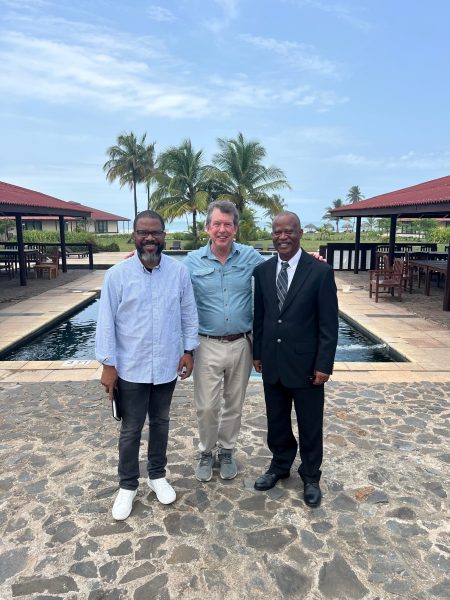
Thank you, readers, for the many encouraging responses to pieces on recent West African travel and our progress with the Applied Scholastics African Literacy Campaign (3/23 – 4/3/23).
Thank you, readers, for the many encouraging responses to pieces on recent West African travel and our progress with the Applied Scholastics African Literacy Campaign (3/23 – 4/3/23). Letter from Liberia (March 24, 2023) and The Wrong Thing to Do: Nothing (March 25, 2023) More from those days? Sure, my pleasure. …
***
Recovery always seems inevitable … looking back. But not so much when trapped in the middle of surging somatic unpleasantness.
While Liberians have welcomed me warmly on return, certain microscopic elements have again sought to slow if not submerge my advance.
By Sat. night (3/25), two days in, the little throat tickle and cough I picked up over the Atlantic have morphed on down to a meaty bronchial invasion, credit and thanks at least partly to the airborne onslaught of road dust, exhaust and other encroaching unhealthinesses.
Since even mild misery loves company, why not have this phlegm-a-thon join with my perennial Liberian nemesis, the angry splotchy rash that starts promptly about the legs and arms, lays down a spectacularly colorful cacophony of pain and itch for a few days, and then relents, no doubt off to torment some other sitting-duck arrival in the tropics.
Hence, long before light Mon. I lay there embattled inside and out. Up to ingest another antibiotic, wash down the limbs, apply ice, elixirs (lavender oil) and ointments; then back under the covers, not to sleep (that’s impossible) but to paint musings up there among the ceiling patterns ...
I travel back to Ghana, July, 2005. Jay asked a simple question in that first week together: “Will you help me?” “Yes,” I said. Neither of us had any idea what that meant, whether or how it would roll out.
But roll out it has. First was the Youth for Human Rights International “African Human Rights Leadership Campaign.” From 2006, the initiative grew annually across Liberia, Ghana and Sierra Leone, activating thousands of young people as human rights educators, teaching by example and deed. Many of the high schoolers who took part are now professionals, doctors, lawyers, educators, administrators, making their way to senior leadership.
With the astonishing 2013 failure of all 17,000 high school graduates to pass the University of Liberia entrance exam and Ebola’s devastation (2014-2016), we have since directed full attention to illiteracy as the emanating human rights violation. Thus came our partnership with Applied Scholastics, with Mr. Hubbard’s Study Tech to enable actual learning for competence over the prevailing “memorize for the test” mass education mindset.
I wander over our ensuing and most recent seven years – dubbed the African Literacy Campaign, working with local youth leaders and a series of accomplished American and South African educators – introducing Study Tech to Liberia’s, and of late Ghana’s, ministries, policymakers, teachers and students. ALC programs have included :
March 29, 2023

It’s the pro bono work that brings the greatest compensation: The light in the eyes, hope rekindled, the dream of creating a future worth living. From last week’s Letter from Liberia , the journey leads to Saturday, March 25, 2023.
It’s the pro bono work that brings the greatest compensation: The light in the eyes, hope rekindled, the dream of creating a future worth living. From last week’s Letter from Liberia, the journey leads to Saturday, March 25, 2023.
***
Sometime this past December I think it was, Jay asked me what I was doing on March 25. Nothing in particular, I believe I said. Save the date, be in Liberia then, he said. OK, I said.
Into January, he kept insisting on March 25 (a Saturday) but wouldn’t say why. Finally, I had to know. Global Cares is going to name the school after you, he said. What?, said I.
***
From my journal, on my first morning in Liberia, June 5, 2006 (less than three years after the shooting stopped):
“We load up the big red rolling bag with the audio-visual and head out south on the main road with Jay driving, myself riding shotgun, Mike, Teewon and Tom in the back. About three miles down, in Congo Town, we pass the abandoned, hulking mildewed concrete post-Apocalypse Defense Ministry from Samuel Doe’s presidency. When Charles Taylor rolled to work in his armed-to-the-teeth Humvee convoy, he would have to pass this monument to Doe’s ignominious 1990 defeat. Jay heads off to the right, in towards the nearby shoreline. He explains that this was the narrow road bypass that all traffic had to take when Taylor lived along the main road just up the way.
“We pass a three story apartment building with the outside walls and stairways blown away; yet still families are living on upper floor rooms, kids clinging, laundry hanging, exposed to the weather. We pass a woman holding a baby chimpanzee in diapers. Then there’s a lagoon, concrete and barb wire enclaves of some wealthy, the poor living over embankments in thatch-walled and pole hovels, dirt yards, children naked in the blue, bright day.
“As the heat presses in, here are families – old down to very young – huddled on low benches and stools, hammering brown and grey rocks into small pieces, piled in short pyramids, then into white-fiberglass throw pillow-sized bags in rows on the shoulder of the road. They are selling these at $30 Liberian apiece, about 60 cents.
“We turn right at Paynesville, onto the airport road, through the first UN checkpoint and past the national “SKD” stadium (Samuel K Doe …). We turn right again, onto a sandy, dirt track around 10:00, towards the surf. We come shortly to a spare, war-scarred house at our left, the Global CARES Mission Academy.
“From the stir as we approach, the whole student body is packed in there. Hard to see into the unlit space, but they’re singing and clapping in full throated unison. A few of the younger ones are peeking and placing their fingers through the worn screens on the front walk. A handwritten poster board sign over the front door says:
“WELCOME MR. TIMOTHY BOWLES TO GLOBAL CARES MISSION ACADEMY. WE THE FACULTY, STAFF, STUDENTS AND FACULTY WARMLY WELCOME YOU AND HOPE YOU ENJOY YOUR VISIT TO LIBERIA.”
“Mother Florence, the 4'10" headmistress – looking in her early 60s (but likely much younger), glowing face, tooth-gaped, hair pulled back tight, right side still black, left side grey – comes out, grabs my hands gently and will not let go. She is outpouring continual thanks that I have come, come to speak with the kids. I smile back.
“Florence guides me into the main room. It’s 200 or so children on benches and at school desks, shoulder-to-shoulder, knee-to-knee, in this 20' x 12' space, all uniformed in blue shirt/blouse and darker blue shorts, the very little ones over here front left, the middle and then still older high school kids right and toward the back. All eyes are on the tall white guy in the Youth for Human Rights International “UNITED” t-shirt. Florence welcomes us.
“The air is still and very warm. As I am talking, sweat starts pouring. We have joked that the reason the UNITED t-shirts are black is because any other color would give away the profuse perspiration that goes on day after day during this work.
“Mother Florence gets the whole group to sing three or so Christian hymns in unison. It is full out and moving. I meet the senior head, Reverend Jerry. He is similarly short and spare, perhaps a little younger than Mother F.
“We are getting good answers on what human rights are, as well as examples of particular human rights and human rights abuses. There is a 12-year-old boy, one eye askew and sightless, and a 13 or 14-year-old girl that regularly volunteer to stand up and answer. Bright. I learn later that a large number of these young boys and girls are orphaned, taken in by Mother Florence and other nearby families. The ones with parents pay tuition. The parentless kids receive their education without charge.
“With our audio-visual ready to go (courtesy the generator we brought, now humming outside), Jay comes in and takes charge. He directs any volunteering kid to come up and stand in front of the class and explain loudly a human right to the others. The same half-sighted boy and the bright girl come up front with him. Jay expands on their answers and explains rights and responsibilities to the rest. He is terrific.
“The little kids are getting restless, but still pretty enthralled with the white man. A few students decide to take a nap on their arms. As we get ready to show the UNITED video, two little ones come forward, one leading the other who is apparently sick and walking home. Malaria?
“The music video is a big hit, projected on the bright white reverse side of the YHRI Liberia banner.
“Tom is thanking everyone for their attention and we are closing it up. Rev. Jerry wants to say a few words. No problem. He pulls out a handwritten speech that looks like it’s going to be several pages long. He thanks us for coming. They have decided that Global CARES is YHRI’s school, their official partner in educating their children.
“I sense what’s coming and sure enough here it comes. Jerry envisions a fully funded school, with renovations of this modest building, or construction of their new one, followed by a nationwide expansion of the Global CARES vision, with schools throughout the counties.
“The students are now dispersing. Jerry, Florence and the staff would like to meet with me. I retire with the four or five school elders into a much smaller room, all squeezing into third grader school desks, chair with wooden writing surface jutting out.
“More introductions. Mother Florence walks over to me and reaches for my collar. With my rear stuck in that tiny desk, I am not going anywhere soon. Tugging, Florence puts the situation plainly: They need money, I have resources, and I am going to help them!
“Perhaps I shouldn’t have been surprised, but was more like stunned. I tell them no guarantee but I would do what I could.”
***
And for the ensuing 17 years and counting, this is what I’ve done, with Jay’s giant assistance and a lot of help from our generous friends back-in-the-States. All through these years, Florence and her principal Reuben Boe have held the fort. (Pretty sure Rev. Jerry was her husband; he passed about a decade ago.)
Florence shortly moved the school and orphanage to her sister’s nearby property. One has to know where it is to find it, around a neighbor’s wall on a non-descript side alley. The two structures are spare to place the best spin on it. Cinderblock construction, no glass windows, a few doors, dirt floors and wide open to mosquitos. The roof blew off the main building a few years back. (We helped with funds to put on a new one.)
Sleeping with and caring for the youngest ones – including Prince, Titus and others from infancy – Florence has weathered Ebola, COVID and every other existential crisis. Prince is now 15 or so, Titus around 12.
Still, with only our modest help, to put me in the school’s name? Jay explained: We show up. Lots of visitors have blown in, promised stuff, and blown out without follow-up. Yet, we have come back on every Liberia trip and with some assistance: Sometimes cash, other times rice, supplies, books.
Truth be, Florence’s and Reuben’s names should be up there, but they were firm: TIMOTHY BOWLES GLOBAL CARES FOUNDATION SCHOOL, last and final demand, non-negotiable.
While diplomacy must prevail, it is ironic that I have spent the past 15-years of fundraising pronouncing that none of us contributing are in this to have buildings named after us. Be very careful what you resist.
Thus, March 25, 2023 has come. With our finance help, Jay has helped Florence and Reuben upgrade the buildings, ceilings, painting, electrical. They have set up the new crew of 200-ish uniformed charges, nursery – 12th grade, under the huge tree in the yard, “dignitary” chairs off to the side. All are assembled. Several of our local team attend, Calvin, Mohammed, Esi. A big fuss is made. Music and two student speakers. Dep. Minister of Education Charles Vonleh presents certs to Jay and me. Mother Florence beats out my praises. The microphone is placed in my hands.
I reenact the Day One Mother Florence incident, calling her over to demonstrate. Laughter. I explain that I have felt welcome here and in Liberia ever since and, truth is, never really went home. You students are assigned the future. Like the huge tree that spreads over us all, if we older people have helped provide you shade under which you can build that future, we have done our job.
Pictures taken. Food and drink for the kids. We take our leave, to return before I leave the country next week. Florence, Reuben, kids don’t yet know that I have also brought two packed suitcases of donated clothing and school supplies. More surprises in store.
Don’t only dead people and really old farts get stuff dedicated to them? I am not dead yet but have I suddenly arrived at least on the edge of the latter?
Tim Bowles
Paynesville, Liberia
Saturday, March 25, 2023

Employers who reserve the right to set compensation rates and pay random, unexpected discretionary bonuses should include a clear handbook policy confirming these points.
Employers who reserve the right to set compensation rates and pay random, unexpected discretionary bonuses should include a clear handbook policy confirming these points.
Policy Drafting Tips:
Take-Aways:
Implement and regularly review a comprehensive, clearly written handbook to include the above policy.
We publish this series to educate employers on best practices for a well-written handbook that assists applicants, employees, and management alike. To purchase our 2023 template handbook – which contains the above policy and much more – and accompanying forms or for more information, please contact Office Manager Aimee Rosales at 626.583.6600 or email her at officemgr@tbowleslaw.com.
See also:
Cindy Bamforth
March 24, 2023