Click here to subscribe to our Bowles Law e-letter


Click here to subscribe to our Bowles Law e-letter
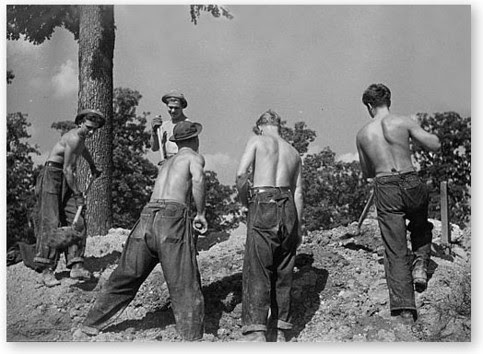
Keep It Cool
High Temperatures
Predicted for the Month
September in California can be one of the hottest times of the year (September Heat Alert). Workplace protective measures against high temperature protections are a priority.
September in California can be one of the hottest times of the year (September Heat Alert). Workplace protective measures against high temperature protections are a priority.
Heat illnesses range from mild to deadly. The two most serious are: heat exhaustion (including dizziness, headache, sweaty skin, fast heartbeat, nausea, vomiting and cramping); and heat stroke (including red, hot dry skin, high body temperature, muscle twitching, confusion, fainting, convulsions and unconsciousness).
Employers with outdoor workers must have an effective written heat illness prevention plan, following Cal/OSHA’s six protective measures:
Employers must also heed preventative measures for indoor workspaces. Heat Ahead Employee High Temperature Protections Are a Priority (May 14, 2026)
Certain industries have additional high-heat requirements, including agriculture, construction, landscaping, oil and gas extraction, and transportation of agricultural products, construction materials or other heavy materials.
Cal/OSHA’s Consultation Services Branch has a help line at 800-963-9424 for workplace health and safety questions.
Take-Aways:
Employers must take heat illness prevention obligations seriously, ensuring they provide such protections to all working in high heat conditions, outdoors and indoors.
For further information, please contact Tim Bowles, Cindy Bamforth or Helena Kobrin.
See also:
Tim Bowles
September 11, 2026

Poster Power
Posting Rules
for California Workplaces
California employers must post required workplace notices where employees can easily see them. Federal law may require more postings based on business size, industry, location, or workforce.
California employers must post required workplace notices where employees can easily see them. Federal law may require more postings based on business size, industry, location, or workforce.
Key Notices:
Main California poster requirements:
• Minimum wage and wage information;
• Paid sick leave and payday information;
• Workplace safety and health;
• Workers’ compensation;
• Employment discrimination and harassment; and
• Employee leave rights, where applicable.
Other notices may apply depending on industry, contracts, minors, location, or local laws. Check the California Department of Industrial Relations’ Required Posters list to confirm requirements.
Federal Focus:
Federal notices may cover wage and hour rules, safety, equal opportunity, family leave, military rights, and lie-detector laws. Consult the U.S. Department of Labor’s Workplace Posters page to confirm which apply.
Know Your Rights Notice:
Starting in 2026, California employers must give employees the Know Your Rights notice by February 1 each year. This is a direct notice to employees, not a poster.
Posting Locations:
Post notices in obvious areas where employees work or pass, like break rooms, entrances, or bulletin boards. Post all required notices at each location.
Some notices have special posting rules for dispersed worksites. Always check for industry or location-specific requirements.
Posting for Offsite Staff:
For remote workers, check if each notice allows electronic delivery and any conditions. Physical posters are still required at worksites. Electronic delivery does not replace workplace posters for most notices.
The All-in-One Option:
An all-in-one California and federal poster can simplify compliance but may miss industry-specific or local notices. Confirm any poster covers all requirements, and supplement if needed.
Take-Aways:
Employers should:
• Identify all required California, federal, local, and industry notices;
• Keep posters up to date at every worksite;
• Provide the annual Know Your Rights notice by February 1;
• Check if electronic delivery is allowed for remote staff; and
• Review requirements often; rules change.
For further information, please contact Tim Bowles, Cindy Bamforth or Helena Kobrin.
See also:
Cindy Bamforth
September 10, 2026

House Call
On the Road in South Africa
Sunday, August 23, 2026Johannesburg, South Africa
This is an African savannah morning, cool turning to cozy in the rising light with those quiet calls of doves: coo-uh-CUCK-ew. Peace across the land, for now.
We Uber from Castle Kyalami to Soweto (So[uth]wes[t]to[wn]), courtesy of driver Nqaboni. In Xhosa, the “q” in the name is pronounced with a click or “TOK” of the tongue against the palate. “N … ” plus “TOK” plus “ … aboni” takes practice.
The 35 minutes are over rolling hills, past innumerable upscale developments – shopping centers, walled fashionable housing, a Land Rover dealership complete with test track. The trees fall way and an “unauthorized settlement” (tightly packed tar paper and tin shantytown) appears next to a polluted stream. Population, 10,000? Soweto’s total is now some 1.8M.
And now here is the paved road, cinderblock Orlando section. Something significant must be coming on this side street, various locals trying to wave us into parking spots. Up a slight incline is Mandela House, evident by lots of white folk exiting a tour bus, greeted by a trio of leopard-skin scantily clad hawkers.
“[My first night back in Soweto following release], I returned with Winnie to number 8115 in Orlando West. It was only then that I knew in my heart that I had left prison. For me, 8115 was the center point of my world, the place marked with an X in my mental geography. The house had been soundly rebuilt after the fire. When I saw the four-roomed house, I was surprised by how much smaller and humbler it was than I remembered it being. Compared to my cottage at Victor Vester [his transition house], number 8115 could have been the servants’ quarters at the back. But any house in which a man is free is a castle when compared to even the plushest prison.” Nelson Mandela, Long Walk to Freedom.
We spend an hour or so at this now-museum of perseverance. It is indeed modest – and to the visitor, humbling -- on a corner that made it the open target of regular apartheid drive-bys and two fire bombings. Bullet pockmarks remain in the brick.
“I have walked that long road to freedom. I have tried not to falter; I have made missteps along the way. But I discovered the secret after climbing a great hill, one only finds that there are many more hills to climb. I have taken a moment here to rest, to steal a view of the glorious vista that surrounds me, to look back at the distance I have come. But I can rest only for a moment, for with freedom come responsibilities, and I dare not linger, for my long walk is not yet ended.” Long Walk to Freedom.
See, also:
Tim Bowles
September 4, 2026

What's New in 2027
California Minimum Wage
Increases January 2027
California’s Department of Industrial Relations has announced an increase in the state minimum wage from $16.90 to $17.40/hour, effective January 1, 2027, for non-exempt workers, i.e., those whom employers must pay overtime and provide meal and rest breaks.
California’s Department of Industrial Relations has announced an increase in the state minimum wage from $16.90 to $17.40/hour, effective January 1, 2027, for non-exempt workers, i.e., those whom employers must pay overtime and provide meal and rest breaks.
Compensation for exempt employees, i.e., those who do not receive overtime and need not be provided those meal and rest periods, also changes on January 1. Salaries to people qualified for the professional, administrative, and executive exemptions must equal at least double the new minimum wage, or $34.80/hour, multiplied by 40. This is $1,392/week, $6,032/monthly and $72,384/year.
The minimum wage increase also necessitates new postings.
Some local minimum wages will also change on January 1. A December blog will provide details.
Take-Aways:
Employers should prepare to implement the higher minimum wage amounts on January 1, 2027.
For further information, please contact Tim Bowles, Cindy Bamforth or Helena Kobrin.
See also:
Helena Kobrin
August 28, 2026
Letter From Liberia
Applied Scholastics Literacy Education Initiative Continues
We came Thursday from Monrovia, over three hours north to Bong County and Gbarnga (“bawn-gaa”). For Applied Scholastics, we are here to introduce Study Technology to a second group of 100 Bong Co educators. Jay and Nigerian colleague Olatunde Odewumi delivered to the first 100 in May; they will wrap with another 100 in November.
Gbarnga, Bong County, Liberia
It would be poetically quiet now in mid-Liberia from this third-floor balcony, dawn coming up through a rainy-season gray but for the grinding air conditioning unit back of my neck and the roosters sounding the obvious down there.
We came Thursday from Monrovia, over three hours north to Bong County and Gbarnga (“bawn-gaa”). For Applied Scholastics, we are here to introduce Study Technology to a second group of 100 Bong Co educators. Jay and Nigerian colleague Olatunde Odewumi delivered to the first 100 in May; they will wrap with another 100 in November.
Our venue is the Nasser Hotel, a four-story concrete and glass facility, built/owned by one of our youth grads from the early human rights education days, 20-plus years back. One knows this facility is Africa, among other things, because: a) the driveway is a nondescript dirt track – likely impassable in the rain – bending around to the seeming backside of the building; b) entry is through a sliding high steel gate, opened by horn honk; c) roving chickens are part of the cleaning crew; d) the blinding sheen of the made-in-China floor tiles is only surpassed by their deadly slickness when wet; and e) looking down at all times in commons areas is mandatory for the sudden and irregular steps up/down. Yet, no complaints. The place is comfortable, secure and home for our time here.
While acute crises such as COVID and Ebola have temporarily crippled Liberian development, the corrosion of educational standards and widespread illiteracy are the enduring plagues threatening life in the region. And so … here we are.
We start just the far side of 9:30. Jay does his intro thing. He assures the assembled we are going to journey way beyond business as usual. Dr. O then does his thing over the bulk of the day, the three study barriers and their solutions, with most attentive throughout.
Our aim was to wrap and hit the road for Monrovia by 5:00. Particularly with rain promised (the Old Testament kind), it’s best to avoid dark night driving over those 90 miles. Dark is the word: street lights are rare and on-the-shoulder walkers flashing out of the gloom plentiful.
Yet, we are not going to shortchange the message to those gathered. It’s 5:30 even before Jay comes back for the finale. I preface him:
“I came to Africa and Ghana in 2005 for a one-week youth conference on human trafficking. Joining us came Jay Yarsiah, in from somewhere called Liberia (not Libya), less than two years after the shooting stopped and spinning out his should-not-have-escaped-death story overlying the amputations, butcheries and other unspeakable brutalities of the 13-year genocide. At the close of that week, Jay asked and I agreed to help in his country … somewhere, somehow.
“And here we are, 20-plus years on. My plan was one week in Africa and out, but I never left. Yes, geographically back-and-forth, but my connection has never severed.
“Most in this room lived through the horror. Those days marked each one of you deeply, whether shot, shooter, sexually violated, and all a witness to the slaughter.
“The world has nothing to offer you at any scale of what you offer the world. Liberians hold out the greatest gift of all, recognition that to love, to live despite all the reasons one could by rights perpetuate the hate and retribution. Together, you affirm the most enduring force of this universe, the human spirit.
“So … thank you.”
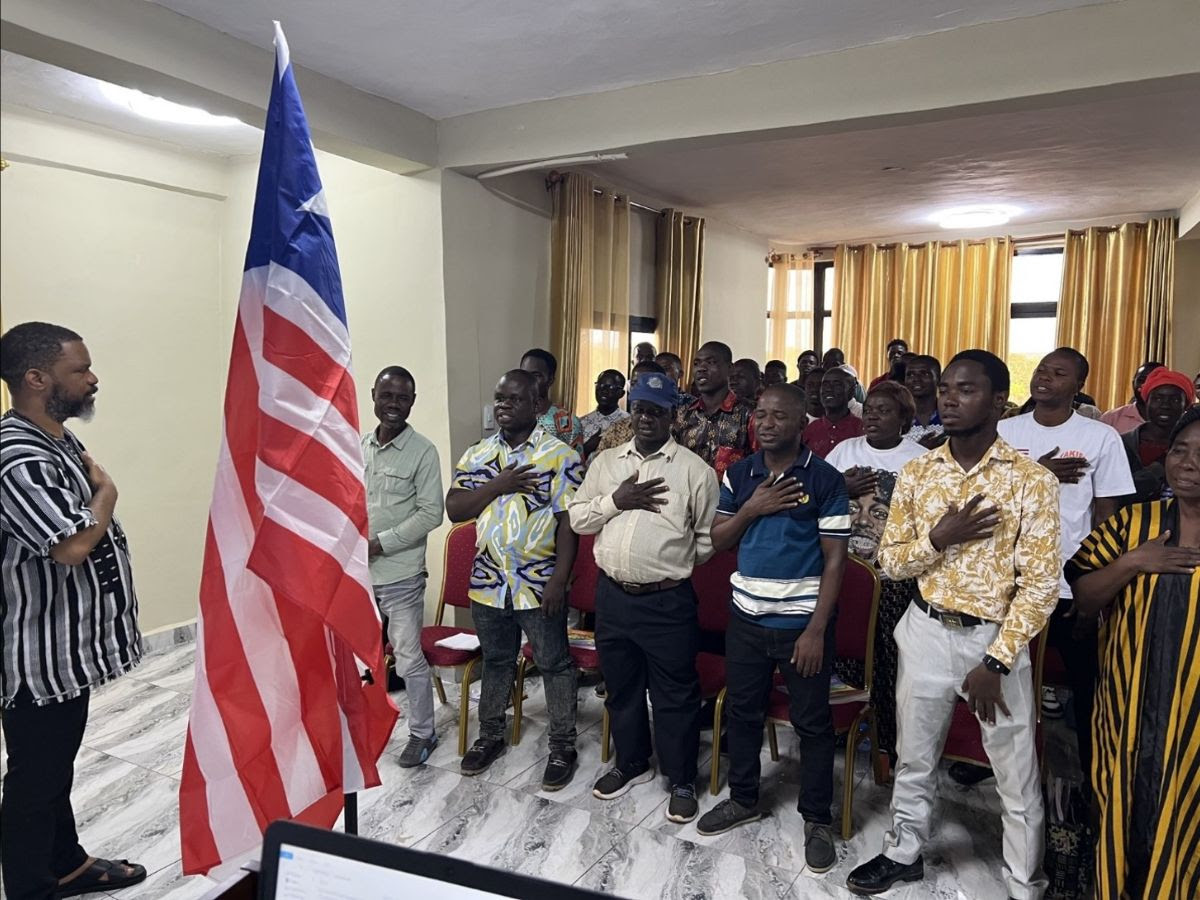
Now comes Jay, passionately reviving purpose and responsibility by walking these educators through the Liberian Pledge of Allegiance for its actual meaning. Together, hand on heart, they intone:
I pledge allegiance to the flag of Liberia and to the Republic for which it stands, one nation indivisible, with liberty and justice for all.
He challenges them. “You have recited this pledge 1000s of times, you lead the pledge in your classrooms, your kids recite it back to you daily. But do you know the actual meanings of the words?”
The answers tend to be boilerplate. Teachers commonly define “liberty” as freedom and freedom as liberty. But it’s not circular and liberty is not some static. It’s a condition of self-determination, to be able to act and to speak freely, that must be maintained, protected.
With the key words defined, they now see the Pledge in a different way. It’s not recited sounds. With literacy, they see it as the Founders did in 1847. 179 years later, Liberians are still fighting for the same thing.
Jay challenges them further: “Educated” does not mean a person is literate. True literacy is not just the ability to read and write. It is the ability to grasp concepts, to evaluate their importances and to operate with judgment toward worthy ends. He asks, “As a teacher, the question becomes what is your commitment to Liberia to educate your students? As leaders in your own right, you have that mission, not the government, the politicians, the pastors or the captains of industry. As a dedicated educator, you can now recognize, ‘This is my responsibility. I didn't cause it, but I'm responsible for it.’"
We are planting seeds. How many will bear fruit?
Wheels are rolling back to Monrovia at 6:30, 30 minutes before sunset. Thus, most of this excursion will be in blackness with our not-so-hot beams, navigation as much by horn and intuition as by steering. Jay is the master, not too fast, not too slow around the ubiquitous motorcycles, less frequent Honda civics and the occasional monster Chinese-made 18-plus wheel haulers.
Out of the murk appear and fade assorted settlements and the two big towns, Weala and Kakata, the headlights suddenly reflecting roadside toddler hands welded to their moms’ as they sweep the kids away from danger, little feet off ground.
It's now 150 minutes in. The traffic thickens outside Coca Cola Factory. Jay throws the dice by going straight on through “Redlight,” the largest market in Monrovia, named after the only wartime traffic light in the country, now gone. That convergence could spell a two- or three-hour wait if jammed. This time, it’s smooth sailing.
We alight upon our Monrovia accommo’s exactly three hours from departure. A helping of pepper chicken and good night, all.
See also:
Tim Bowles
Saturday, August 15, 2026
Cautionary Tale Episode 115
Silence isn't Agreement
Arbitration Agreement Struck Down for No Employee Acknowledgement
A federal appeals court refused to enforce an arbitration agreement against employee Scott Rickes because Thermo Fisher Scientific could not prove he agreed to it.
A federal appeals court refused to enforce an arbitration agreement against employee Scott Rickes because Thermo Fisher Scientific could not prove he agreed to it.
Thermo Fisher sent Rickes four emails with a link to its Mutual Dispute Resolution Agreement (MDRA), which would bind employees unless they opted out within 45 days. Rickes never opened the emails or clicked the agreement link yet continued working past the deadline. When Rickes sued for age discrimination, Thermo Fisher argued his continued employment showed acceptance of the MDRA.
The court disagreed. Under California law, electronic assent requires affirmative action: opening the agreement, clicking through, or otherwise engaging with its terms. Because Thermo Fisher's records showed no such action, continued employment was insufficient.
Employers should not rely on emailing or posting arbitration agreements online. They must confirm receipt and obtain acknowledgment or signatures, following up when necessary.
Take-Away:
Employers must obtain documented signatures or acknowledgments on arbitration agreements. Silence, inaction, or continued employment alone does not create an enforceable agreement.
For further information, please contact Tim Bowles, Cindy Bamforth or Helena Kobrin.
See also:
Helena Kobrin
August 14, 2026

Cautionary Tale Episode 114
Bug Curb Reverb
Labor Commissioner Secures
$2.75 Million for
Hotel Workers Not Rehired After Pandemic
California’s Right to Recall Law, Labor Code 2810.8, enacted after the massive layoffs in 2020-2021, requires airport service providers, hotels, event centers, and private clubs to first offer jobs to employees terminated on or after March 20, 2020 due to the pandemic. The law extends to January 1, 2027.
California’s Right to Recall Law, Labor Code 2810.8, enacted after the massive layoffs in 2020-2021, requires airport service providers, hotels, event centers, and private clubs to first offer jobs to employees terminated on or after March 20, 2020 due to the pandemic. The law extends to January 1, 2027.
The Labor Commissioner has now settled with the Anaheim Marriott Hotel for $2.75 million for failing to notify 24 such job-qualified workers who had worked for the company for at least six months before pandemic-caused lay-offs.
Lilia García-Brower, California Labor Commissioner, stated:
“Hospitality workers made tremendous sacrifices during the pandemic and eligible workers deserved a fair opportunity to return when businesses reopened. When employers failed to honor that obligation, our office followed the facts, enforced the law, and secured a settlement that provides meaningful relief to affected workers.”
Take-Aways:
Employers in the hospitality industries must continue to make jobs available to workers laid off because of the pandemic through the end of 2026.
For further information, please contact Tim Bowles, Cindy Bamforth or Helena Kobrin.
See also:
Helena Kobrin
August 7, 2026
What's New in 2026
Safety Poster Refresh
Cal/OSHA Updates
Required Workplace Notice
In April 2026, Cal/OSHA updated the “Safety and Health Protection on the Job” Notice to correct contact information for its Santa Barbara and San Francisco district offices without creating new workplace-safety rules.
In April 2026, Cal/OSHA updated the “Safety and Health Protection on the Job” Notice to correct contact information for its Santa Barbara and San Francisco district offices without creating new workplace-safety rules.
California employers must post required workplace notices in a conspicuous place at each physical establishment. Failure to meet Cal/OSHA posting requirements can result in civil penalties up to $12,471 per violation.
The updated Notice appears in CalChamber’s California and Federal Employment and Labor Law Poster.
Next Steps:
Take-Away:
Employers should display the updated Cal/OSHA poster or supplemental Notice at each workplace.
For further information, please contact Tim Bowles, Cindy Bamforth or Helena Kobrin.
See also:
Cindy Bamforth
August 5, 2026
Paper Cut Chaos
Small Compliance Gaps Fuel
Class Action Frenzy
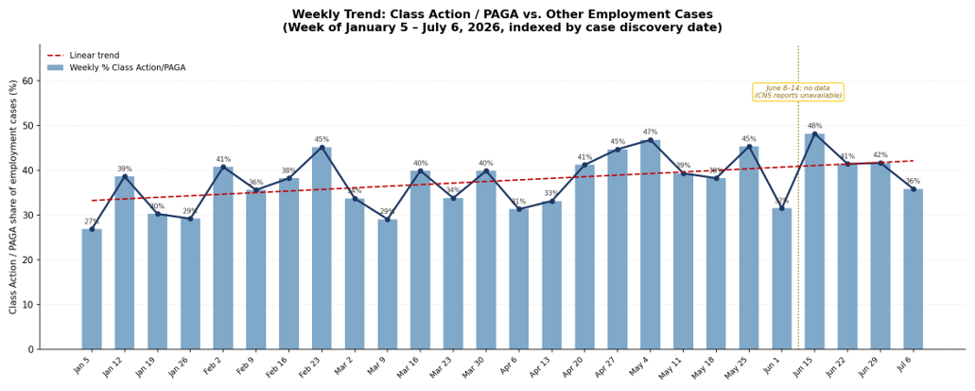
California’s employers are in the midst of a growing litigation epidemic, the wage-and-hour class action — a lawsuit built around one policy or practice applied to a company’s entire workforce, the exposure multiplied by every employee it touches and every pay period it covers.
California’s employers are in the midst of a growing litigation epidemic, the wage-and-hour class action — a lawsuit built around one policy or practice applied to a company’s entire workforce, the exposure multiplied by every employee it touches and every pay period it covers.
Class actions live and die on one question: is there a common policy or practice that affected a group of employees the same way? The lawyers aren't looking for one employee perhaps shorted some overtime. They're looking for a payroll rule, a scheduling practice, or a handbook provision that applied uniformly and thus permits a court to magnify a single violation to dozens, hundreds, or thousands of workers extending four years back from the date of filing.
The underlying facts are often mundane:
None of these individually would justify a major lawsuit. Yet, as they stem from a company-wide policy rather than an isolated manager's mistake, like the virtually certain speeding ticket if one drives long enough, it’s only a matter of time before that business may be tagged with a class case.
This state offers a special boost to this unpleasantness. Routinely, plaintiffs' firms add a PAGA (Private Attorneys General Act) layer to the class claims. See, e.g., PAGA Monster Declawed --Major Relief for Responsible Employers (June 28, 2024)
Take-Aways:
For further information, please contact Tim Bowles, Cindy Bamforth or Helena Kobrin.
See also:
Tim Bowles
July 31, 2026